

The Myall Creek Massacre
A moment that changed Australian history
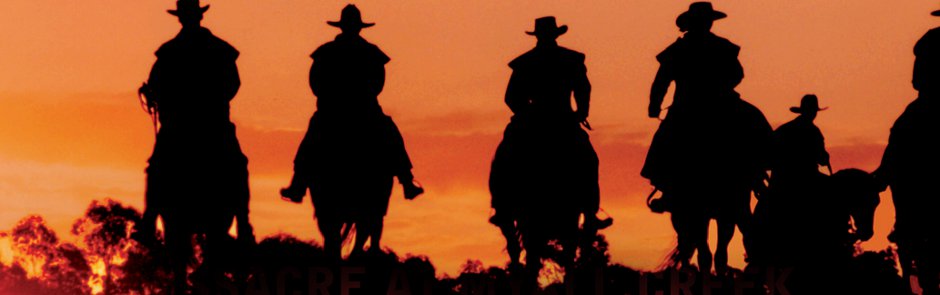
On 10 June 1838, a group of armed stockmen rode onto Myall Creek Station near Bingara in north-west New South Wales and killed 28 Wirrayaraay women, children and old men of the Gamilaraay nation.
The victims had been living peacefully on the station when they were bound and led away from the huts before being killed. Their bodies were later burned in an attempt to destroy evidence.
The massacre at Myall Creek was one of many acts of violence that occurred during the Frontier Wars as European settlers expanded across Aboriginal lands. These conflicts and massacres were widespread across Australia and often went unrecorded.
Yet the events at Myall Creek became historically significant for another reason.
BACKGROUND, 1788–1837
The infamous massacre of Aborigines at Myall Creek in Northern New South Wales in June 1838 occurred in the fifty first year after the British began their penal colony near Sydney cove.
The encroachments of the Europeans brought years of devastating strife to Aboriginal peoples, who had lived on this country for thousands of years. They suffered terribly, as they were exposed to diseases to which they had no immunity and they died in large numbers. They were driven from their lands, which had sustained them physically and spiritually. Demoralised and degraded, they were coming to be seen as a doomed race.
A proportion of the white population abused them, despised them and coveted their lands. The first British Governor, Captain Arthur Phillip, was, in the poet Les Murray’s words, ‘a kindly, rational man’, who attempted to develop harmonious relations with the Aborigines.
However, he and subsequent leaders failed to bridge the cultural gaps and failed to protect Aborigines from those who tormented them. Likewise, that proportion of the white population who sympathised with the Aboriginal peoples were usually powerless to prevent atrocities on the frontier. Even the judgement of those who sought to help Aboriginal people was often clouded by presuppositions of cultural superiority. There was little knowledge of or value given to Aboriginal languages and belief systems.
As the pastoral industries continually advanced into Aboriginal lands, those in the vanguard of occupation were aware of their isolation and numerical inferiority. Some feared a rising of the tribes and lived with a siege mentality. Any news of Aboriginals clashing with whites or interfering with livestock could be a spur to action. With the closest agents of the British law several days’ ride away, low level skirmishes gave way to atrocities of which the massacre at Myall Creek is an extreme, though well documented, example.
THE EVENTS OF 1837 AND EARLY 1838
In the early or middle part of 1837, Myall Creek Station was established by Henry Dangar and became part of his pastoral empire. In 1837 and 1838, the station was managed by William Hobbs, a young freeman from Somerset whose personal staff comprised three assigned convicts: Charles Kilmeister the stockman, George Anderson the hut keeper and Andrew Burrowes, mainly responsible for the horses.
According to author Roger Milliss, there was a constant fear of Aborigines – real or imagined. All the men went armed when they were away from the shelter of the station. However, there were no Aborigines to be seen and Milliss comments that by mid 1837 the area immediately north of Bingara, extending up to Myall Creek, originally peopled by the Wirrayaraay or Wolroi tribe, may well have been swept clear of its traditional owners.
By 1837 the centre of the conflict had shifted downstream on the Gwydir. There were a number of incidents in which killings of a few white people or livestock resulted in large scale killings of Aboriginal people.
Major James Winniet Nunn came from Sydney at the end of 1837 and with a party of about 30 troopers and some volunteer stockmen conducted a murderous campaign extending over 53 days. In one incident, up to 300 Aborigines may have been killed in a surprise attack at Snodgrass Lagoon on the Waterloo Creek on January 26th, 1838. According to oral history gathered by the late Len Payne of Bingara, the Gwydir exploded in a fresh outburst known as the ‘Drive’ or the ‘Bushwack’, at the beginning of May 1838. Towards the end of May or early in June, a large party of Aborigines were reported to have been surprised at dawn in a ravineat the headwaters of Slaughterhouse Creek, with heavy loss of life.
Shortly before this, a group of about 50 Aboriginals moved to Myall Creek Station at the invitation of Charles Kilmeister. They had been living at Mclntyres – a cattle station about 30 kilometres upstream from what is now Bingara. They had been urged to move by their friend Andrew Eaton, a hut keeper at Mclntyres, who feared for their safety. Milliss comments,
“Everything points to an unusual bond developing between the little clutch of whites and the crowd of blacks who had suddenly descended on them, something approaching real friendship, not just for the enticing of young girls, but for the older men and their children as well – all taking place in the short space of a fortnight or three weeks.”
(Waterloo Creek p. 282)
THE EVENTS OF JUNE 10–15TH, 1838
On Sunday morning, ten of the Aborigines, representing just about all of the able bodied males, including ‘King’ Sandy, accompanied Thomas Foster, the superintendent of Newtons, a neighbouring station, to assist him cut bark.
They arrived about four in the afternoon, only to learn that a party of armed stockmen had visited the previous day and had plans to go onto Dangars. Foster prevailed upon the Aborigines to return immediately to Myall Creek. By half past four they were on their way. But they were already too late.
About half past three or quarter to four, a group of at least 10 and possibly 12 stockmen came galloping up to the huts of Myall Creek Station, brandishing their guns and swords.
Unfortunately for the Aborigines, who were preparing their evening meal, William Hobbs, the station superintendent, and Andrew Burrowes, one of the assigned convicts, were absent from the station. It is likely that the marauding gang knew this.
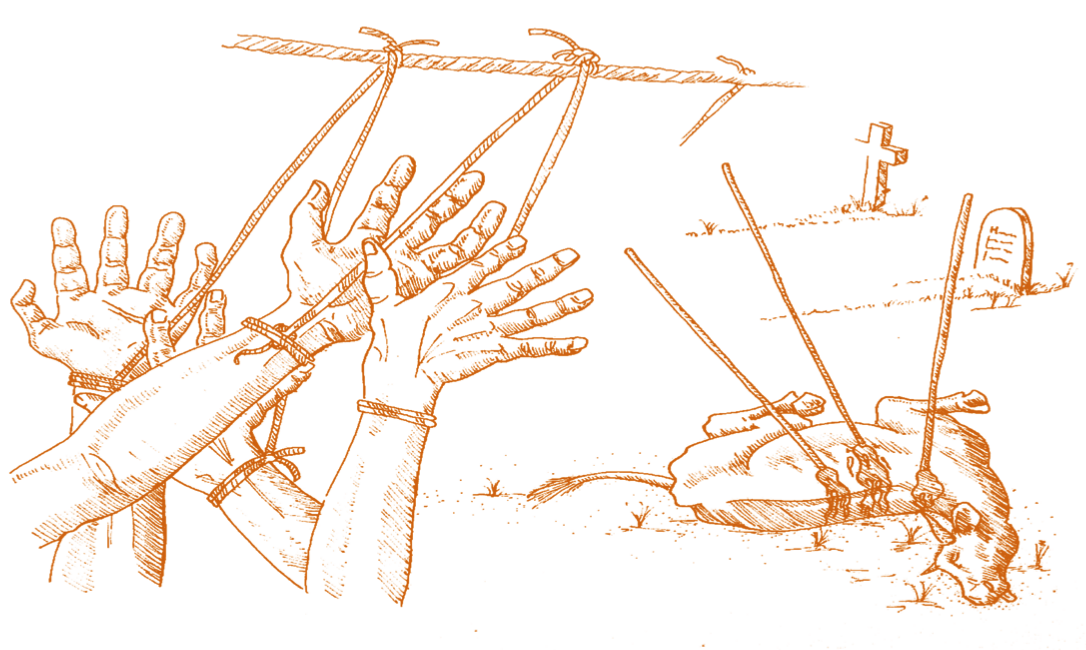
The horsemen herded the Wirrayaraay into the workmens’ hut with only two boys aged about eight or nine able to escape. One of the stockmen, John Russell undid a long tether rope from around the horse’s neck, entered the hut with one or two others and began tying
the defenceless people’s hands together.
Despite his evening socialising with the Aborigines Charles Kilmeister, one of the station convicts, joined with their tormentors. George Anderson, another of the assigned station convicts, refused to join and was later prevailed upon to give evidence against them. He identified John Fleming, the only perpetrator not of convict origin, and John Russell as the ring leaders. Charles Telluce, James Oates, William Hawkins, Edward Foley, George Palliser, Jem Lamb and the mixed-race ex-seaman, ‘Black’ Johnstone, were implicated. Anderson was uncertain about two others, John Blake and James Parry.
Anderson later recalled that many of the group of 25 or 30 Aborigines had been given nicknames, including one man named ‘Daddy Daddy’. He was a ‘very old, big tall man’, whom William Hobbs later described as the ‘doctor of the tribe’. He has been spoken of as the clan’s ‘clever man’. Old Joey, Tommy Sandy and his wife Martha and their precocious son Charlie, who was liked by everyone and was William Hobbs’ special favourite, were others Anderson recalled.
The stockmen were deaf to the cries of their victims. Within twenty minutes of first arriving, the mounted men surrounded their frantic captives and they were hauled forward by a man with the end of the rope hitched to his saddle. They headed west from the hut, with Anderson watching until they had disappeared from view over the top of a rise. Two solitary shots were heard 15 or 20 minutes later.
There is no eyewitness account of the killings. About 800 metres from the huts, the defenceless black people were hacked and slashed to death. Only one of the whole clan was spared –John Blake appears to have selected an Aboriginal woman. All of the other Aboriginal people were beheaded and their headless bodies were left where they fell. It is thought that the gang spent the night camped out, carousing and recalling their bloody deeds. Meanwhile, Anderson waited at the hut, later claiming to have never visited the site. Davey slipped away and brought back news of what he had seen. Not knowing what the murderers next move would be, anderson kept those who had avoided capture with him.
At 10pm, the ten Aboriginal men who had been away at Newton’s arrived at Anderson’s hut and learned the awful story of what had befallen their kin. They had covered close to 50 kilometres during the day. But now, with Anderson’s urging and Davey interpreting they were persuaded to get as far away from the station as possible.
By 10.30pm, the ten men, two women and three boys headed off into the night, towards Maclntyres.
THE MURDERERS’ RETURN
On Monday afternoon, the murderers returned to Anderson’s hut and spent the night there and, on Tuesday morning, set about burning the bodies of their victims.
SUBSEQUENT MASSACRES
It appears that the group of Aboriginal men reached Maclntyres on Wednesday, June 13th and that, no sooner had they arrived than the stockmen caught up with them.
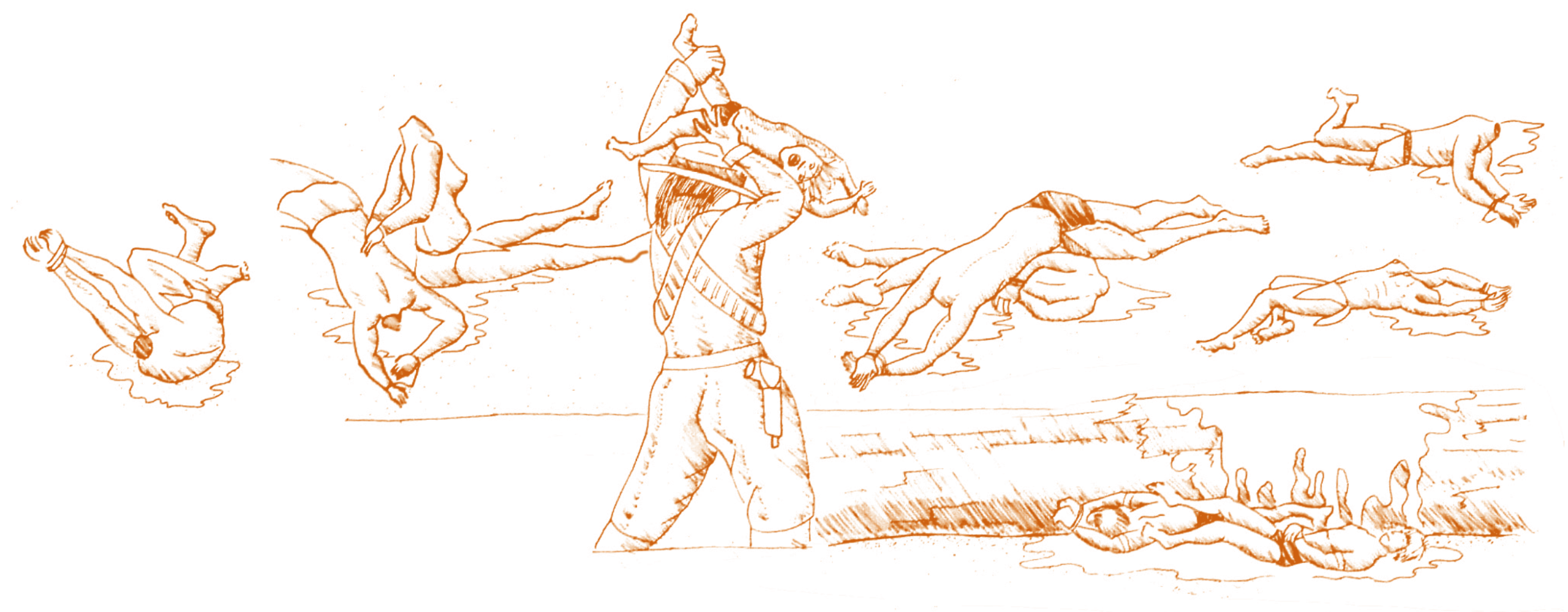
Worse, it seems likely that the murderers were guilty of another outrage near Maclntyres, even more horrific than that at the Dangars. From reports gathered by the missionary, Lancelot Threlkeld, between 30 and 40 Aborigines were murdered and their bodies cast onto triangular log fire.
An woman’s throat was reported to have been cut; she was allowed to run with blood spurting and then was thrown alive onto the fire. Her infant child was thrown alive onto the fire. Two young girls were mutilated by the gang. It is likely that after these events, the stockmen were involved in several days of heavy drinking and their party dispersed on Friday, June 15th 1838.
The pursuit of justice
Unlike most frontier killings, the Myall Creek massacre was reported and investigated.
George Anderson, the hut keeper who witnessed the aftermath, informed the station manager William Hobbs, who in turn reported the crime to authorities. The investigation was led by magistrate Edward Denny Day.
Eleven of the twelve men responsible were arrested and charged with murder.
The first trial resulted in an acquittal. However, a second trial of seven men followed, focusing on the murder of a child. This time the jury returned a guilty verdict.
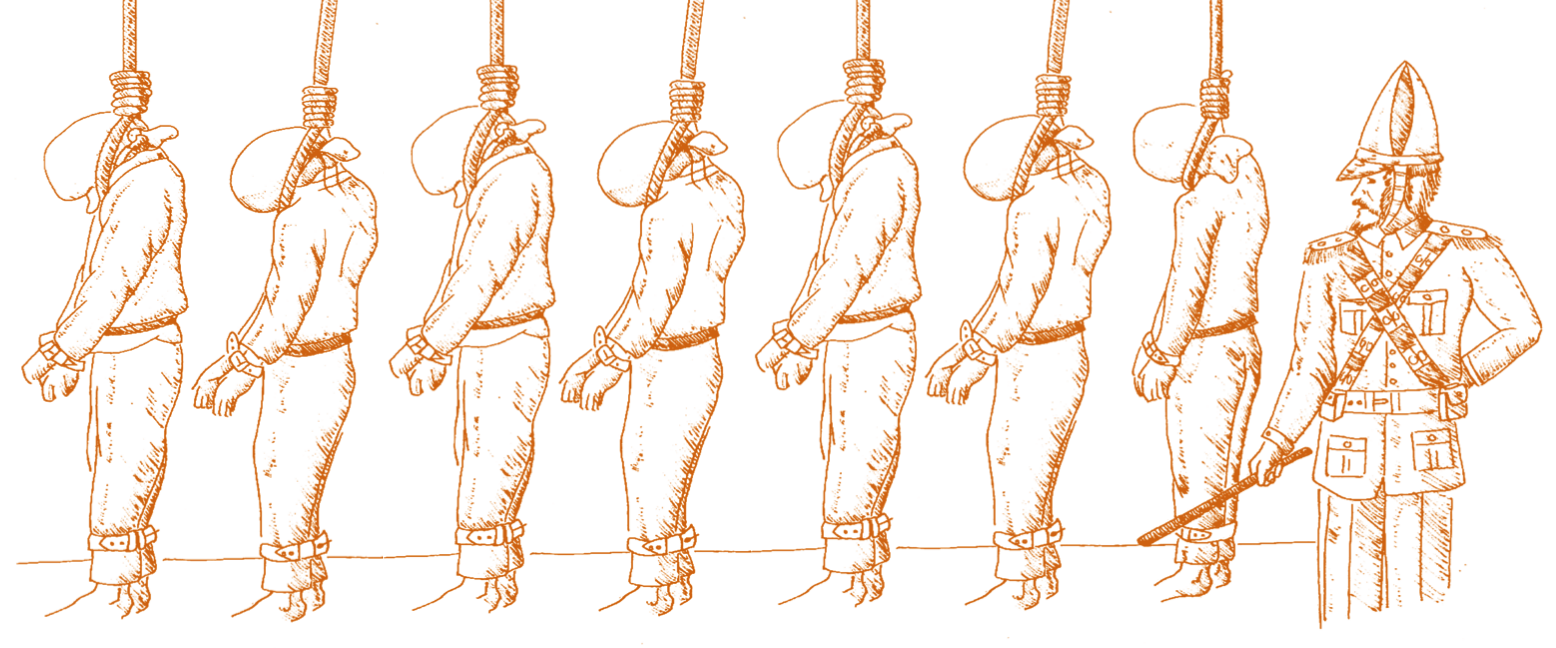
In December 1838, seven men were convicted and executed by hanging.
This was the first and only time in Australian history that non-Aboriginal perpetrators were executed for the massacre of Aboriginal people. The court records stand as rare and powerful evidence of frontier violence and the struggle for justice.
AN OUTRAGE REVEALED
On the same afternoon, Dangar’s superintendent, William Hobbs, returned to Myall Creek, having already gained some information about what had occurred in his absence.
He questioned Anderson and accepted Kilmeister’s denial of complicity.
He was then guided by Davey to the site of the massacre, noting footmarks and tracks of horses cast hard in the soil after recent rain. At least 20 separated heads and a mass of bodies were together in a haphazard pile. The stockmen’s attempt to burn the bodies had failed because of the damp wood.
Hobbs spent between fifteen and twenty minutes at the site, becoming at one stage stricken with nausea.
The next morning, Hobbs and Thomas Foster inspected the site for a briefer period.
The men agreed that the atrocity should be reported and Hobbs undertook to inform his employer, Dangar. He did, though, let it be known that he was going to report it to the authorities as well.
By Sunday, June 24th, Frederick I. Foot, a landholder, set off to Muswellbrook to report the matter to the nearest police magistrate, Edward Denny Day. Missing Day, he travelled on to Sydney and, on July 4th, wrote an account of the incident for the attention of Governor Gipps. Governor Gipps, only in the colony four months and anxious to implement British Government instructions to protect Aborigines, gave the report precedence over other matters, including an inquiry into Major Nunn’s activities. Edward Denny Day, supported by a party of mounted police, was instructed to institute a strict inquiry and to apprehend all those responsible.
THE INVESTIGATION
Denny Day probably left Muswellbrook on Thursday, July 19th, and his expedition occupied 47 days.
On Saturday, July 28th, having spent time gathering witnesses and seeking suspects named by Foot, he opened his inquiry, with Foster as the first witness.
That afternoon, Day visited Myall Creek Station with Hobbs and inspected the site.
However, there were remarkable changes to what Foster had described to Day that morning. The site of the massacre gave the appearance of having been swept, though there were fragments of bones and the remains of the fire. Day took charge of part of a lower jawbone, a child’s rib and a number of teeth.
It is thought that, in the intervening six weeks since the massacre, the murderers and perhaps some accomplices, returned to relight the fire and destroy evidence.
That evening, Day ordered Kilmeister taken into custody on suspicion of involvement and set about hearing Hobbs’ account. Then it was Anderson’s turn. He implicated Kilmeister for the first time.
Following persistent interrogation of Burrowes, Day identified ten suspects, four of whom he had in custody. In the ensuing days, the magistrate travelled widely through the area, taking evidence and seeking suspects.
He missed the freeman, Fleming, at Mungie Bundie Station on the Gwydir River. Fleming was never captured. It is thought that he returned to his parents’ home on the Hawkesbury river, near Sydney.
By Wednesday August 8th, Day and the mounted police had gathered ten suspects. George Anderson was now questioned further and he was now prepared to identify eight of the men as belonging to the murderous party. Day charged Blake on the strength of information from other witnesses.
The prisoners walked for about 300 kilometres under guard and in chains to Muswellbrook, in the Hunter Valley, arriving on September 10th. Within a week, all but one were under lock and key in Sydney. During the trip through the Hunter, John Russell escaped, but was recaptured by mid October.
THE LEAD UP TO THE TRIALS
In the Hunter, Day’s investigation and the arrival of the prisoners attracted wide interest.
A fund was set up to defend the prisoners and landholders met to lobby the Governor. Soon, a vociferous campaign erupted over the trial of the Myall Creek men. It is thought that a clandestine organisation of Hunter Valley landlords, many of whom also
had holdings in the North Western Districts, were the driving force in this campaign.
In September of 1838, Mr. Robert Scott, a prominent landholder on the Hunter and on the Gwydir (an area close to Myall Creek), visited the prisoners in the Sydney gaol and told of his plans to finance their defence.
He said that the one witness against them was insane and they should hold together and not inform on each other. In early October, Henry Dangar visited Myall Creek Station and dismissed William Hobbs. However, Dangar insisted Hobbs complete his contract by mustering some 500 cattle. But when Hobbs received a subpoena to appear as a witness in the coming trial, he responded to that duty above other concerns.
Meanwhile, in Sydney, controversy raged in the press and in public meetings. An attempt to form an Aboriginal Protection Society was short-lived. By early November, public opinion was running in favour of the accused.
FIRST TRIAL – NOVEMBER 15TH, 1838
Chief justice James Dowling presided in the Supreme Court, with the prosecution led by the AttorneyGeneral, John Hubert Plunkett. Seated with the three defence lawyers was Mr Robert Scott.
There was no observer of the crime and no body had been recovered. The accused pleaded not guilty.
Thomas Foster, the first crown witness, was circumspect. Hobbs was more forth-coming, but had to concede that he could not positively identify the body of Daddy.
In essence, Edward Denny Day’s evidence amounted to his having come across the traces of an old fire and picking up a few fragments of bones. He was not cross-examined.
The defence tried to destroy Anderson’s credibility, firstly by reference to Anderson’s request that Ipeta be left for him. His reluctance to provide information was raised with the suggestion that he was seeking his liberty by giving evidence favourable to the prosecution. When his contract in the colony and reason for deportation were raised, however, he stood up for himself and had the better of the exchange.
Further witnesses included a dentist, who agreed that the bone fragment consisted of a jawbone with two teeth, several other burned teeth and a rib bone, apparently from a child.
The defence case first sought, unsuccessfully, to have the prosecution disallowed on the grounds of circumstantial evidence. Then, surprisingly, instead of calling in their 30 witnesses the defence only called for testimony as to the good character of their clients. Dangar supported Kilmeister and attacked Anderson.
In his summing up, Chief Justice Dowling said that no-one could be convicted of murder unless a body was found. Therefore the jury had to determine whether ‘Daddy’ was the ‘unfortunate man’ whose remains Hobbs has seen.
The jury filed out of the courtroom at 9.30pm and were back within 15 minutes. To the cheering in the court, all the accused were pronounced not guilty. However, Attorney General Plunkett immediately asked that the prisoners be remanded, as he wished to prepare another indictment. To hissing, Dowling granted the application.
Two days later, the date of the second trial was set for Monday, November the 26th.
Much of the publicity following the first trial expressed revulsion at the facts that had been revealed. For once, attacks on Aborigines in sections of the press briefly abated. Instead, there were attacks on Governor Gipps, who, it was said,
contributed to public ill feeling against Aborigines by not ordering stronger measures against Aborigines. New waves
of ‘attacks by lawless savages’ were reported from the Gwydir area.
THE SECOND TRIAL
Judge William Westbrooke Burton presided in the second trial. Only seven of the original group were accused – Kilmeister, Oates, Foley, Parry, Russell, Hawkins and Johnstone. Plunkett hoped that the defence would put the others, Lamb, Palliser, Telluse and Blake on the stand for cross-examination.
The charges now centred on the killing of an Aboriginal child. A total of 20 counts were alleged, including five that nominated a precise victim, ‘Charley’.
A jury was sworn and asked to decide whether the prisoners had previously been tried for the murder of an Aboriginal child. When the jury decided in the negative, the trial recommenced
on November 29th, before another jury.
Thomas Foster was again the first witness. He firmly believed that none of the skulls he saw were those of children. Hobbs, as a second witness, gave definitive evidence concerning the
presence of children. He said that the children’s skulls were in the centre of the mess and Foster had not examined as closely as he.
On leaving the witness box, Hobbs was arrested for failing to settle an outstanding debt. This appeared to be an attempt to hinder justice and the over zealous bailiff was fined two pounds for contempt of court.
Next, Day repeated his evidence and suggested that Kilmeister had perhaps been coerced by other members of the group to join them in the atrocity. Anderson weakened the crown case
as he was unable to swear that Charley had been taken away.
The defence began by stating that it was not even certain that the boy had been killed, but Burton ordered that the trial should proceed. The defence went straight to character witnesses, Dangar being first. As before, he supported Kilmeister and attacked Anderson. Plunkett sought to undermine Dangar’s credibility by drawing attention to his suspension from a public office. He was questioned about his dismissal of Hobbs, about Hobbs’ wrongful arrest and about Dangar’s contribution to the prisoners’ defence fund.
The following witness, Thomas Hall, was discredited when he had to admit that he visited the northern stations only twice a year. There were no further witnesses.
In his summing up, Burton directed that the jury should first consider the question of Charley separately. He was scathing in his assessment of Dangar and noted that the murdered Aboriginals had given no provocation. Masters, he said, should ensure that their stockmen used arms only in extreme provocation.
The jury filed out and returned after three quarters of an hour with the foreman pronouncing the defendants ‘not guilty’ on all counts. However, when he sat down, another juror rose
and announced an error. He said the men had been found guilty of the murder of an Aboriginal child whose name was unknown.
This agreed, the judge complimented Hobbs on the part he had taken to report the murder.
EPILOGUE
The seven convicted were executed at 9am on December 18th, 1838. Governor Gipps fought a losing battle with the squatters and his commitment to justice for Aboriginals waned. Major Nunn’s activities on the Gwydir were never investigated. Henry Dangar’s pastoral holdings grew. William Hobbs was unemployed for several
years before becoming a constable at Wollombi in 1846.
The murderous attacks on Aborigines, including the use of arsenic and other poisoning, by European settlers continued on the frontiers well into the 20th century.
162 years after the massacre a Memorial to the Aborigines of Myall Creek was dedicated on June 10th, 2000.
Remembering the Wirrayaraay
For the Wirrayaraay people, the massacre was a devastating loss of life and culture.
The victims were part of a community that had lived on and cared for this land for countless generations. Their identity and connection to Country were deeply rooted in the land, waterways and seasonal cycles that sustained them.
Today, the names of the victims are not fully known. But their memory lives on in the stories shared by descendants and through the memorial created on this land.
Our truth-telling and shared history
The story of Myall Creek is part of a broader national story.
Across Australia, many similar massacres occurred as colonisation spread. Most were never investigated or acknowledged at the time.
Myall Creek stands as a rare historical record — a moment where truth was documented and justice, however limited, was pursued.
Recognising this history is essential to understanding Australia’s past and moving toward reconciliation.
The Wider Historical Content
THE BRITISH INFLUENCE
Australia, from its colonial birth, was a government-managed penal colony, subject to the policies of the government of the day and the Colonial Office, who administered them.
Plunkett not only introduced equality before the law for Aboriginal people in 1836 but also pursued a career-long campaign for the acceptance of evidence by Aboriginal people in criminal trials.
The winds of change however had not blown through all the ranks of government. Just prior to the arrival of Gipps, acting Governor, Lieutenant Colonel Kenneth Snodgrass had commissioned Major Nunn to organise a force ‘to suppress outrages in the Namoi Gwydir region’. Nunn’s expedition cut a bloodthirsty swathe across the north-west, for which he was warmly congratulated by the press, the squatter fraternity and elements in the government including Snodgrass. It was in this setting that the actions of Gipps, Plunkett and Denny Day were endeavouring to bring justice for Aboriginal people in New South Wales, following the Myall Creek Massacre.
THE EXPANSION OF THE SHEEP LANDS
Initially, New South Wales survived as a colony on the exports of whale oil and seal skins but was soon looking for an economic reason to exist.
With the recovery of the British economy after 1828, investment poured into Australia. The price of wool increased all through the 1830’s and peaked in 1837 eventually collapsing in 1839–41. The agricultural property boom starting about 1834 was well under way in 1838, to reach its peak in 1840. With the speculative mindset well and truly in place by 1838 the development of the land now known as the New England, was undertaken by many of Scottish descent who through the Highland Clearances of 1811 were not unfamiliar with the removal of people unable to protect themselves, so that sheep could flourish.
So while wool had a dramatically beneficial effect for the Australian economy, it came at a great cost. It led to the forced removal of Aboriginal people from their traditional lands and numerous massacres which continued well into the 20th century.
A GLOBAL EXPERIENCE
The Australian experience was not unique. 1838 was a year in which a whole range of events illustrated the world in which the massacre took place.
Timeline History
A story that continues
The story of Myall Creek did not end in 1838.
More than 160 years later, descendants of both victims and perpetrators came together to create the Myall Creek Memorial — a place of remembrance, reflection and reconciliation.